
What Monterey Park Resident Lookup Confirms
A Monterey Park resident lookup has no single master result. Los Angeles County separates assessment, recording, elections, tax, court, and vital work among different custodians. The useful first move is to tie the person to a known fact, then choose the record built for that fact. An address can lead to an AIN and parcel history. A name plus a recording year can lead to the offline grantor and grantee index. A court event can lead to a case number. A family event may require an authorized or informational certificate, not a web search.
| Record | What It Confirms | Where | Access |
|---|---|---|---|
| Assessor parcel | AIN, situs, value, characteristics, and a mailing-versus-situs clue | LA Assessor Property Search | Free web search; owner names limited online |
| Recorded deed | Named grantor or grantee, legal description, recording year, and instrument number | LA RR/CC Real Estate Records | Offline index; counter, mail, or copy order |
| Voter verification | Status for one supplied name, birthdate, house number, and ZIP combination | LA County Voter Registration Verification | Free self-check; files are purpose-restricted |
| LASC or federal case | Party role, case number, filing date, status, docket events, and lawful image access | LA Superior Court or PACER | Name search and images may cost fees |
| Vital record | Birth, death, marriage, or limited divorce confirmation and relationship facts | LA RR/CC or CDPH | Copy type and relationship control access |
| Business or license filing | Business affiliation, registrant, license status, or professional location | SOS bizfile, FBN, city, or DCA | Free indexes; affiliation is not residence |
| Directory, yearbook, or paper | Historical occupant, classmate, community role, obituary, or address context | Bruggemeyer Library Local History Room | Appointment research; exact runs vary |
Run the narrowest useful source first. An old address calls for the Assessor Portal, eGIS, and then a deed bridge. A name tied to a legal event calls for the Los Angeles Superior Court party search. A family-history question may call for the county recorder, CDPH, newspapers, probate, or yearbooks. A business clue belongs in FBN, bizfile, a city license request, or DCA. Each row above supplies a lead, not a final identity finding. Keep the record date, the jurisdiction, and the party role beside the name as you work.
Build a Monterey Park Resident Evidence Grid
Write down the known facts before opening more portals. A one-person evidence grid keeps a search from turning into a pile of names. Put the exact spelling in one column, then record the source, date, place, party role, and the next check it suggests. If a result has no date or geographic tie to Monterey Park or Los Angeles County, mark it as a lead only. The grid also makes it easier to explain a correction to the custodian when an official entry is wrong.
- Name form
- Record the full entry, initials, former surname, hyphen, space, or original-script form so the searched variant is clear.
- Independent anchor
- Keep an AIN, old address, spouse, parent, occupation, school, or case number to separate a likely person from a namesake.
- Date and place
- Note the recording year, filing date, event county, ZIP, or library volume year to test whether records can belong together.
- Role
- Label grantor, grantee, plaintiff, respondent, registrant, licensee, agent, or occupant instead of treating each as the same identity.
- Next proof
- Save a document number, certified-copy route, clerk counter, or second independent source that can turn a lead into a checkable record.
Use at least two independent records whose dates and geography align. A deed can establish a named ownership event, but it does not establish every occupant. A permit can name an applicant or contractor, but not prove who slept at the address. A court party can be connected to a case without being a Monterey Park resident. The grid makes these limits visible instead of hiding them in a final summary.
Defeat Monterey Park Same-Name Records
Monterey Park name research needs more than a single Latin-letter spelling. The Bruggemeyer catalog was built to support Chinese, Japanese, and Korean vernacular searching, and its local holdings include International News Daily and China News Daily microfilm. Where the catalog or record system allows it, test the original script and each documented romanization. Search Western-name order and family-name-first order. Keep spaces, hyphens, initials, and accent marks in separate passes rather than silently stripping them.
For Spanish-language family records, preserve birth or maiden surnames and test both surnames when the form supports them. A spouse name, middle initial, school, occupation, or old street can be a stronger anchor than a broad name hit. Do not merge two people because they share a common family name, especially when one result is a business agent and another is a deed party. The correct resident lookup is the one that survives a date and place check.
There is a timely spelling detail here. The 2026 change under AB 64 permits specified diacritical marks on California birth, death, fetal-death, and marriage records. Preserve those marks when they appear. A mark can distinguish a faithful official name from an older index form, and a missing mark can explain why a search needs a second pass.
Search Monterey Park Court Records by Role
The Los Angeles Superior Court Party Name Search is built for civil, small claims, family-law, and probate participants. Its documented fields include party last or business name, first and middle name, case type, date range, and court location where offered. Guest and registered modes lead to the same basic need: narrow the name, save the case number, and read the party role before drawing a conclusion. Criminal name search is a separate paid service, and the Criminal Defendant Index no longer uses date of birth as a public name-search criterion as of February 26, 2024.
| Result field | Record in the grid | What it does not prove |
|---|---|---|
| Party name and role | Exact entry plus plaintiff, defendant, petitioner, respondent, decedent, or interested-party role | That the party lived at a Monterey Park address |
| Case number and court | Number, courthouse or district, case type, filing date, and status | That two people with the same name are one person |
| Register of actions | Event or document title, filed date, hearing date, location, and result when public | Access to sealed, juvenile, adoption, or restricted material |
| Document image | Selected filed pages and filing date after case-number lookup | A complete file when remote access is limited |
For the Criminal Defendant Index, the published coverage is felony cases from 1980 to the present and misdemeanor cases from 1988 to the present, with some former municipal-court cases automated to 1983. Traffic and infractions are excluded. A guest search is $4.75. Registered users pay $1 for searches 1 through 10 in a month, followed by tiered rates. Keep the search narrow and save the case number rather than paying for repeated broad searches.
Selected LASC images cost $1 per page for the first five pages, then $0.40 for each added page, with a $40 maximum per document. Blank imaged pages count. Court Archives copies are $0.50 per page, and a clerk terminal or counter is the fallback for older or non-digitized material.
The Los Angeles Superior Court fee information page is the source for the image and name-search fee screen used when planning a narrow resident lookup.
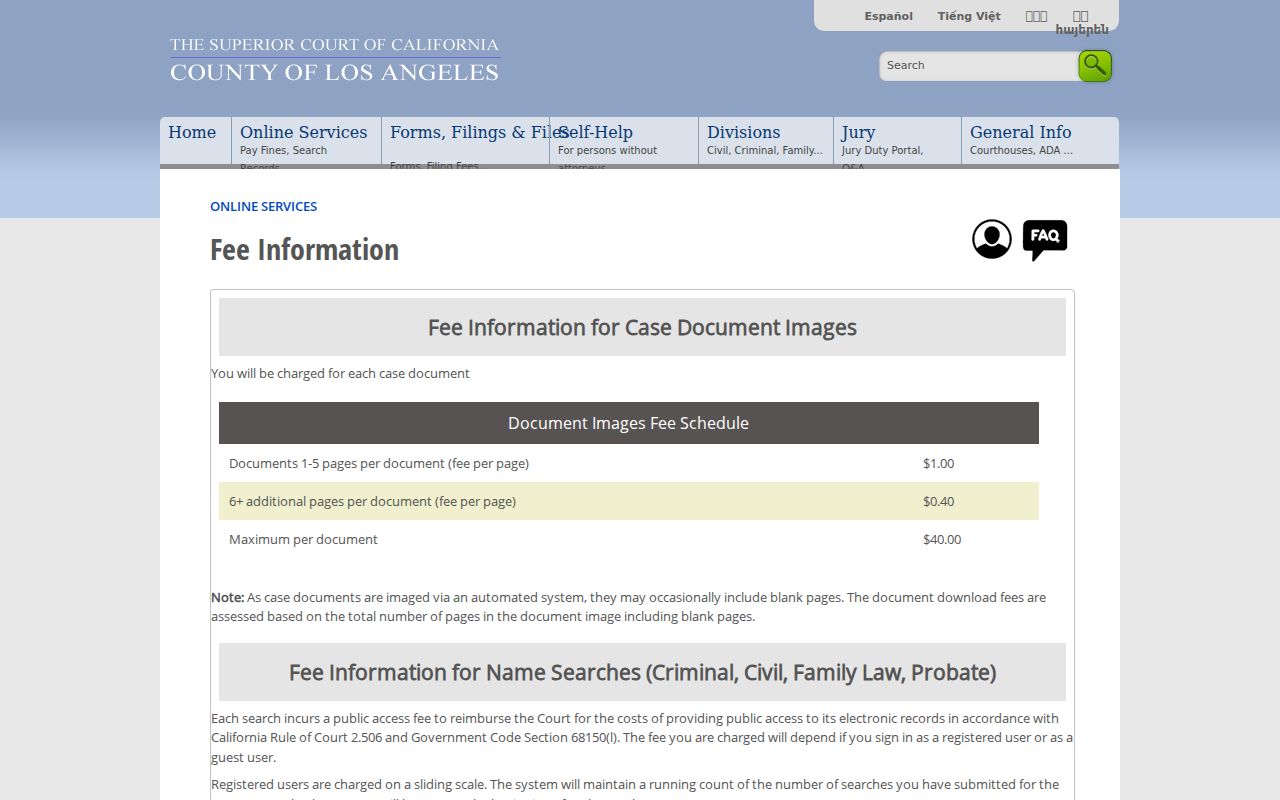
Use the fee page to budget for the exact case or image you need; it does not turn a name hit into proof of identity.
The federal path is different. Monterey Park federal matters belong to the Central District of California, and PACER searches by party name, case number, court, date, or nature of suit. PACER charges $0.10 per page with a $3 cap per document under the published schedule.
The official PACER site is the correct starting point for a federal docket, party, or filing search tied to Monterey Park.
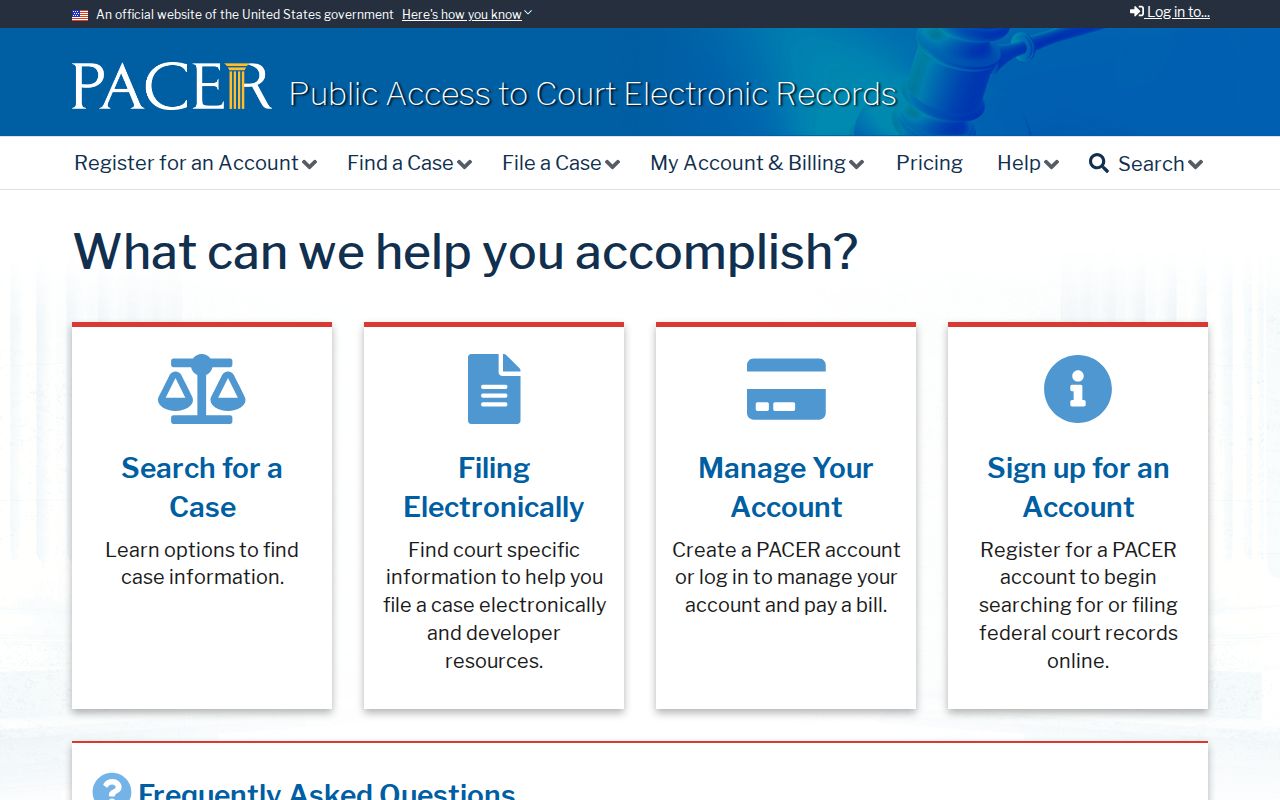
Record the federal court, docket number, party role, and filing date together because a namesake can appear in an unrelated case.
The Central District of California court site supplies the local federal court context behind a PACER result.
When a remote record is limited, use the case number and the assigned clerk or archive channel instead of guessing from a party name alone.
- Docket
- A dated register of case events and filings, not the whole file.
- Index versus image
- An index points to a party, case, or document; an image is the filed page that the custodian permits you to view or buy.
- Certified copy
- A copy issued with the custodian's certification for a permitted purpose; an ordinary web result is not certified.
Verify Monterey Park Voter Records
Los Angeles County's voter tool is self-verification. It requires Last Name, Birthdate, House Number, and ZIP Code, with the house number entered as numbers and the ZIP as five digits. A match confirms the submitted combination and can route the requester to election information. It does not display everyone registered at an address. A non-match calls for spelling, a prior address, or a county check, not a claim that a person does not live there.
- Last Name
- Alphabetic text that tests the name supplied to the county record.
- Birthdate
- MM/DD/YYYY, adding the personal anchor needed for self-verification.
- House Number
- Numbers only, testing the residence number supplied by the requester.
- ZIP Code
- Five digits paired with the name, date, and house number.
Full voter and street files are not a general resident directory. Elections Code sections 2188 and 2194 and Government Code section 7924.000 restrict address, contact, identifier, and signature data. Approved election, scholarly, journalistic, political, or governmental purposes require the proper order, contract, and purpose certification. Countywide files are listed at $146; a precinct, district, or city file is $54, with an additional file at $39. The Street Index is priced at $0.50 per thousand names for candidates and committees. The general public may obtain it only for political purposes at $0.10 per page plus $1.60 handling, under contract. Commercial use is prohibited.
That distinction matters in a resident lookup. Use the free self-check for the person who is verifying their own status, and treat any authorized file as a regulated election record. Neither channel is permission to build a street roster or infer who else shares an address.
Choose Monterey Park Vital Records Carefully
California uses an authorized-versus-informational distinction for ordinary birth and death copies, rather than a simple rule that every record is closed for a set number of years. Health and Safety Code §§103525-103526 limit authorized certified copies to listed relationships, official roles, or a court order. An informational certified copy is generally available through the applicable route, but it is marked not valid to establish identity. Confidential marriage records are different: Family Code §§509-511 limits access to the parties or a court order.
| Record route | 2026 fee | Access point and caution |
|---|---|---|
| LA County birth | $34 | RR/CC county event route; copy type and relationship matter |
| CDPH birth | $31 | Statewide mail route; authorized request needs a sworn notarized statement |
| Death | $26 | LA RR/CC or CDPH; authorized and informational paths differ |
| Public marriage | $19 | LA RR/CC or CDPH; use names, date, and county |
| Confidential marriage | $19 state schedule where applicable | County of issuance; parties or court order under Family Code §§509-511 |
| Divorce certificate | $18 | CDPH certificate is not the complete LASC judgment or file |
Los Angeles County birth records cover county events since 1866. In-person service for 1962 to the present has an exception for 1972 to 1977; the older span and exception years are handled by mail, as are informational copies. Applications ask for the registrant's full name, event date and place, both parents' names at birth, applicant contact information, relationship or purpose, copy count, payment, and a notarized sworn statement for an authorized mailed request.
The Los Angeles County marriage-record page is the county source for the marriage route and its copy choices.
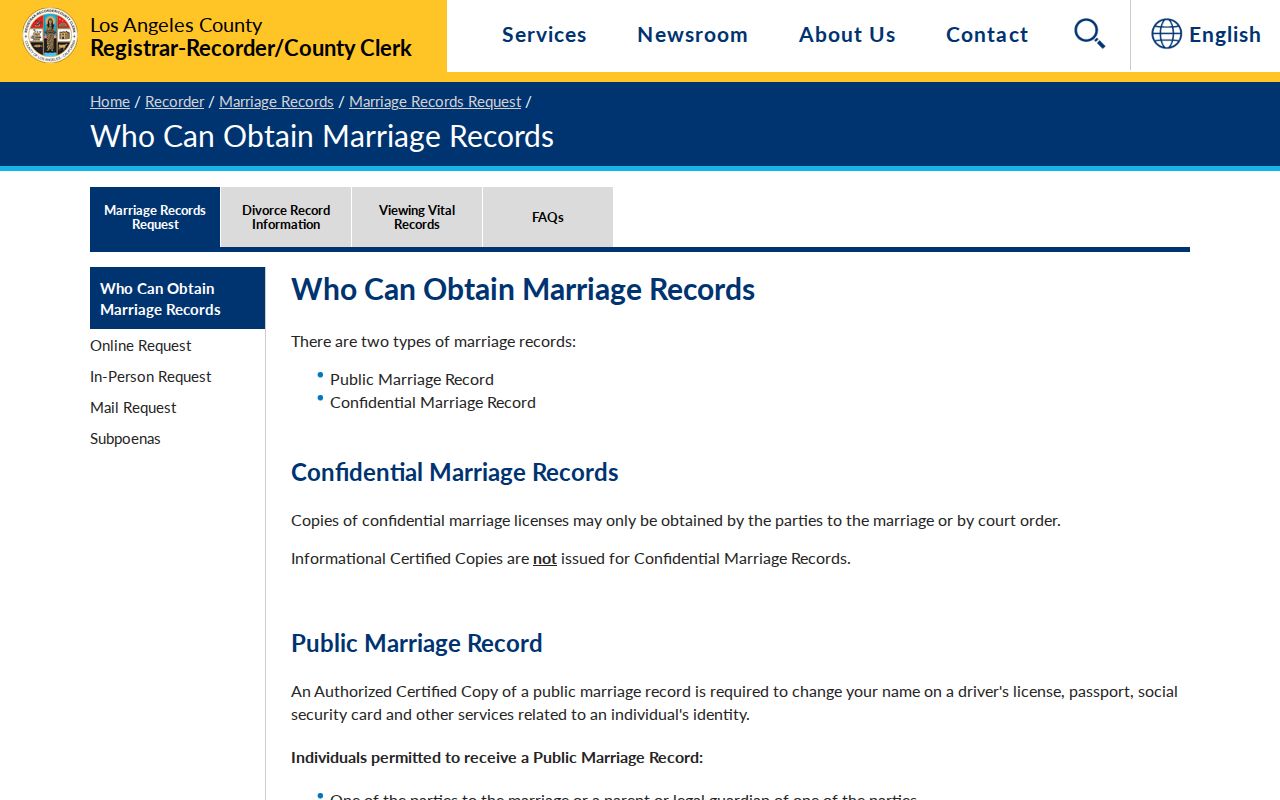
A marriage index or certificate can support a relationship link, but it still needs a date and place match before it is tied to the right person.
The Los Angeles County death-record page explains the county death-copy route used for an obituary, probate, or heir trail.
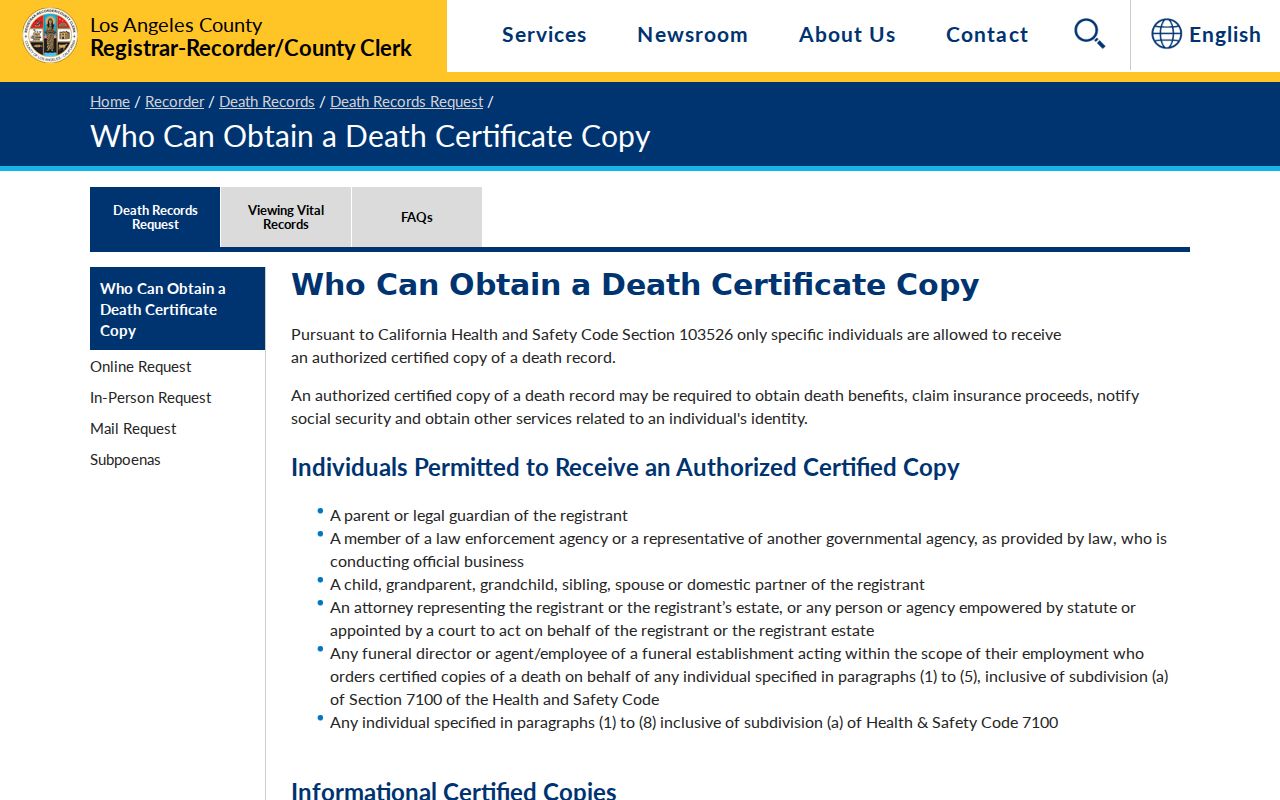
Use a death record to test a date and family link, then return to the probate or deed custodian for the legal record that follows.
The Los Angeles County birth-record page gives the county application path, while CDPH handles its statewide route and current state fee.
Birth, death, and marriage records are identity clues only when the copy type and eligibility fit the person asking for the record.
Follow a Monterey Park Family Record Route
Probate is a useful lawful route when the question concerns an heir or an estate. A Los Angeles Superior Court probate result may identify a decedent, petitioner, heirs, attorneys, and filing events. Read the party role, then test the death date against a vital record and the property link against a recorded deed. A probate petition is not a free-standing proof of current residence, and a case may contain restricted pages.
For a birth-parent search, California has no open birth-parent directory. In the CDSS Mutual Consent Program, a birth parent submits Consent for Arranging Contact, form AD 902, to CDSS or the licensed adoption agency that handled the adoption. Contact information may be shared only if the adult adoptee, age 18 or older, also consents. Agencies may not solicit consent or act as a general search service. If the agency is unknown, CDSS Post Permanency Services Unit accepts AD 902 at 744 P Street, MS 8-12-521, Sacramento, CA 95814; the listed phone is 916-651-8089 and the email is cdsspostadoptionservices@dss.ca.gov.
For a former classmate, Mark Keppel High School yearbooks, Bruggemeyer newspapers, obituaries, and oral histories offer a better starting point than a broad compiled profile. The useful pattern is yearbook to obituary to probate or family record, with each step checked against its custodian and date.
Separate Monterey Park Business Records
A business filing can help identify a person, but it answers an affiliation question. The California Secretary of State bizfile index can show an entity name, number, type, status, jurisdiction, agent, and public filing history. A Los Angeles County fictitious business name filing can show a registrant or business address. Monterey Park's business-license records can show a local licensed name, location, classification, issue or expiration, and status through the city route. DCA Search adds board, license type, name, city, county, or ZIP filters for many professions.
- Corporation or LLC: California SOS bizfile supplies entity affiliation, not a private residence.
- Fictitious business name: the LA County RR/CC FBN service supplies a registrant and filing trail with party roles kept distinct.
- Local business license: Monterey Park Finance or a public-record request supplies a local operating record, not proof of ownership or occupancy.
- Professional license: California DCA Search supplies credential status and a published location, not a home address.
- Unclaimed property: the State Controller search supplies a historic name, city, address fragment, holder, or property type; proof is still required for a claim.
Search the full name, city, and ZIP where the form permits, and copy the role shown by the record. A registered agent, professional practice address, business owner, and resident are not interchangeable. Unclaimed-property results can be stale, so they are a clue to follow with a date-matched official record, not a present-location claim.
Privacy Limits on Monterey Park Resident Lookup
California's Public Records Act, Government Code §§7920.000 et seq., is a narrow fallback when the right city or county department is known and the record is identifiable. The agency normally makes an initial determination within 10 calendar days and may extend that determination by up to 14 days in unusual circumstances. Describe the department, record type, subject, and tight date range. CPRA does not override vital-record access rules, voter-file limits, court sealing, DMV restrictions, or privacy exemptions.
Safe at Home gives qualifying survivors of domestic violence, stalking, sexual assault, human trafficking, elder or dependent-adult abuse, and qualifying reproductive-health workers or patients a substitute mailing address. A protected address should not be exposed by casual cross-checking. If an official record is wrong, take the correction to the custodian: an Assessor roll correction, court procedure, vital amendment form, voter update, or license-board process each has its own route.
California's 2026 DROP privacy portal gives consumers a centralized deletion request route for registered data brokers. Registered brokers begin processing centralized requests on August 1, 2026 and must process them at least every 45 days. DROP rights concern covered business data; they do not erase lawful government records or change a deed, docket, or vital certificate. Use the official portal, save confirmation, and check again when the data source has a stated recheck cycle.
Lawful use. A Monterey Park resident lookup is for lawful personal research, family history, reconnection, and civic understanding. Do not use a record to stalk, follow, threaten, dox, or harass anyone; California Penal Code section 646.9 and related civil remedies set real limits.