
What Monterey Park Neighbors Records Can Show
A Monterey Park neighbors search should begin with a block-lookup question, not a demand for a household roster. The Los Angeles County Assessor eGIS map can show parcel geometry and AINs. The Assessor roll can add situs, value, and property characteristics, with owner-name limits online. A deed names parties to an ownership event. City permit and code files add work or notice history. Library, council, and newspaper sources add time and community context. Each source answers a different question about the block.
| Source | What It Shows About a Block | Access |
|---|---|---|
| LA Assessor eGIS parcel map | Parcel outlines, AINs, situs details, and the lots touching or near one address | Free map and click identify |
| LA Assessor property roll | Property class, values, characteristics, mailing-versus-situs clues, and transfer indicators | Free address or AIN search; owner names limited online |
| RR/CC recorded documents | Grantor, grantee, legal description, recording year, and document trail for each parcel | Offline name-and-year index, counter, mail, or copy order |
| Monterey Park permits and code | Work, applicant, contractor, inspections, notices, responsible owner or agent, and resolution context | Citizen Access for October 1997 to present; older or sensitive files by request |
| LA County voter files | Regulated registration information only when the requester has an approved purpose | Contract, purpose certification, and fees; never a general block list |
| Bruggemeyer reverse directories | Listed past occupants, businesses, street order, and neighborhood history | Local History Room appointment; exact runs are not published |
| Council minutes and newspapers | Petitions, projects, civic participants, obituaries, moves, and local events | Library microfilm, city records, or a narrow request |
Owners, mailing recipients, permit applicants, and occupants are separate roles. A parcel map does not name every household. A mailing address can differ from the situs, and that difference can have more than one explanation. Treat it as a reason to check a deed or a dated directory, not as proof about who your Monterey Park neighbors are.
Monterey Park Neighbor Address Search
The eGIS viewer is useful because it lets a researcher move from one known address to adjacent parcel polygons. Start with the subject address or AIN. Zoom until the parcel lines are clear. Select the subject polygon, record its AIN and situs, close or shift the identify panel, then click each touching or nearby polygon one at a time. Keep a hand-built AIN list. The map is a geometry aid, not a resident export, and no reliable public radius download was located.
- Enter the known address or AIN in the LA Assessor eGIS viewer and confirm the city and street.
- Click the subject polygon and copy the AIN, situs house number, street, ZIP, and any displayed map or tract clue.
- Close or move the identify result, then click each adjacent polygon, including lots across the street when the question is the immediate block.
- Put every AIN in a dated list and remove duplicates caused by repeated map clicks or multi-parcel sites.
- Open the Assessor property search for each AIN, then move to the recorder, permits, or library source that answers the next question.
This process keeps the boundary visible. A whole named street needs a longer address chain, while the immediate block needs parcel-by-parcel checks. When the goal shifts from nearby lots to every address on one road, use the Monterey Park street directory for the full street-by-street record path.
Build a Monterey Park Neighbor AIN List
The Assessor Portal offers Basic Search, Legal Search, and Map Search, with the main query framed as search by AIN or address. An AIN is a ten-digit parcel identifier commonly grouped as a four-digit map book, three-digit page, and three-digit parcel. The public web search is strong on land facts, but LA County suppresses owner names online. The ArcGIS parcel layer exposes geometry and situs fields, not a resident roster.
- AIN or APN
- A stable parcel key for a map click, tax bill, deed bridge, or permit search, but it identifies land, not a person or every unit.
- Situs address
- House number, fraction, direction, unit, street, full address, city, and ZIP; the physical location can differ from mailing address.
- Legal description
- Tract, lot, block, and map references that help with older records; deed and map language controls when street text changes.
- Property facts
- Class, year-built or improvement details, values, exemptions, and transfer indicators; tax facts are not proof of occupancy.
- Owner name
- A possible bridge to a recorder party search through a lawful channel, but not reliably displayed on the public internet portal.
For a specific property owner, the research notes a phone route at 213-974-2111 or 888-807-2111 option 6, a counter visit, or the Specific Property contact channel with the complete address or AIN. That is a parcel-level inquiry, not permission for bulk harvesting. An owner-name answer still needs a deed date and party role before it can be used in a block history.
Monterey Park Deed and Permit Records
Los Angeles County RR/CC recorded real-estate records reach back to 1850, but the property index is not a public online address search. It is organized by grantor, grantee, and recording year. For each AIN on the block, first obtain a lawful owner or party bridge, then search the name and year at the recorder counter or through the documented request route. A later deed can supply a prior seller, legal description, book and page, or document number for the next step.
Recorder access includes in-person search and copy at Room 2207 from 8 to 5 Monday through Friday except holidays, mail to the Real Estate Records Section in Norwalk, and an online copy order after an instrument is identified. A plain copy is $5 for the first page and $3 for each additional page. A certified copy is $6 for the first page and $3 for each additional page. A name-and-year search is $0.50 per name and year, with a $1 minimum. A card payment carries a $1.75 handling or service fee. The recorder cannot search by street address or sell selected pages only.
Permits fill a different gap. Monterey Park Building Citizen Access covers October 1997 to the present and can search by address, permit or record number, project name, date span, licensed professional, contact, and parcel number. Results may name an applicant, architect, engineer, contractor, owner, inspection, issue date, final date, or project description. Earlier records are at the Building and Safety counter. Code Compliance files can add complaints, notices, responsible owner or agent, and resolution, but privacy and investigation rules can redact parts. None of these fields proves who occupied the parcel.
Keep the deed, permit, and code roles in separate columns. A grantor may be a seller, a permit applicant may be a contractor, and a responsible agent may not be the person who lives at the site.
Read Historical Monterey Park Neighbors in Context
The Bruggemeyer Library Local History Room is the strongest local fallback when a parcel map cannot answer who was listed near an address. It holds Monterey Park City Directories, three cabinets of microfilm, Mark Keppel High School yearbooks, vertical files, photographs, oral histories, and City Council minutes from 1916 to 2011. Physical work requires an appointment through Reference at 626-307-1368. The official page names the collection but does not publish a complete directory year and publisher run.
A catalog search limited to Monterey Park can miss the 1930 to 1931 Alhambra directory that NARA confirms includes Monterey Park, El Monte, Rosemead, San Gabriel, Temple City, and Wilmar. Inspect the title-page abbreviation key, then check alphabetic and reverse street sections if the volume has them. An entry may contain a surname, given name or initial, spouse, occupation, home marker, business address, and sometimes a residence-status symbol. Treat that listing as historical evidence, not current occupancy.
Newspapers add reasons for a change. Monterey Park Progress, Cascades, Journal, and Comet files, along with Los Angeles Times, International News Daily, Alhambra Post Advocate, and China News Daily microfilm, can place a move, obituary, club, petition, or business event beside a street name. Council minutes can surface petitioners, commissioners, project proponents, and civic speakers. Copy the date and context so a public voice is not mistaken for a parcel owner or a member of an unnamed group.
Monterey Park Neighbor Voter Files by Law
The free LA County voter-status tool is self-verification, not a block search. It requires last name, birthdate, house number, and ZIP Code. It confirms the combination submitted by the requester and does not show the other registered voters at the address. The separate voter and Street Index files require an applicant identity, organization or contact details, requested geography, output choice, purpose category, signed use contract, certification, and payment.
Countywide files are listed at $146. A precinct, district, or city file is $54, and an additional file is $39. Candidates and committees pay $0.50 per thousand names for the Street Index. The general public may obtain that index only for political purposes at $0.10 per page plus $1.60 handling. Elections Code sections 2188 and 2194 and Government Code section 7924.000 protect address, contact, birth-date, signature, and identification fields. Ballot choices are never in participation history, and knowing unauthorized acquisition or use can be a misdemeanor.
The LA County voter and election file access page shows the order and fee context behind this restricted channel.
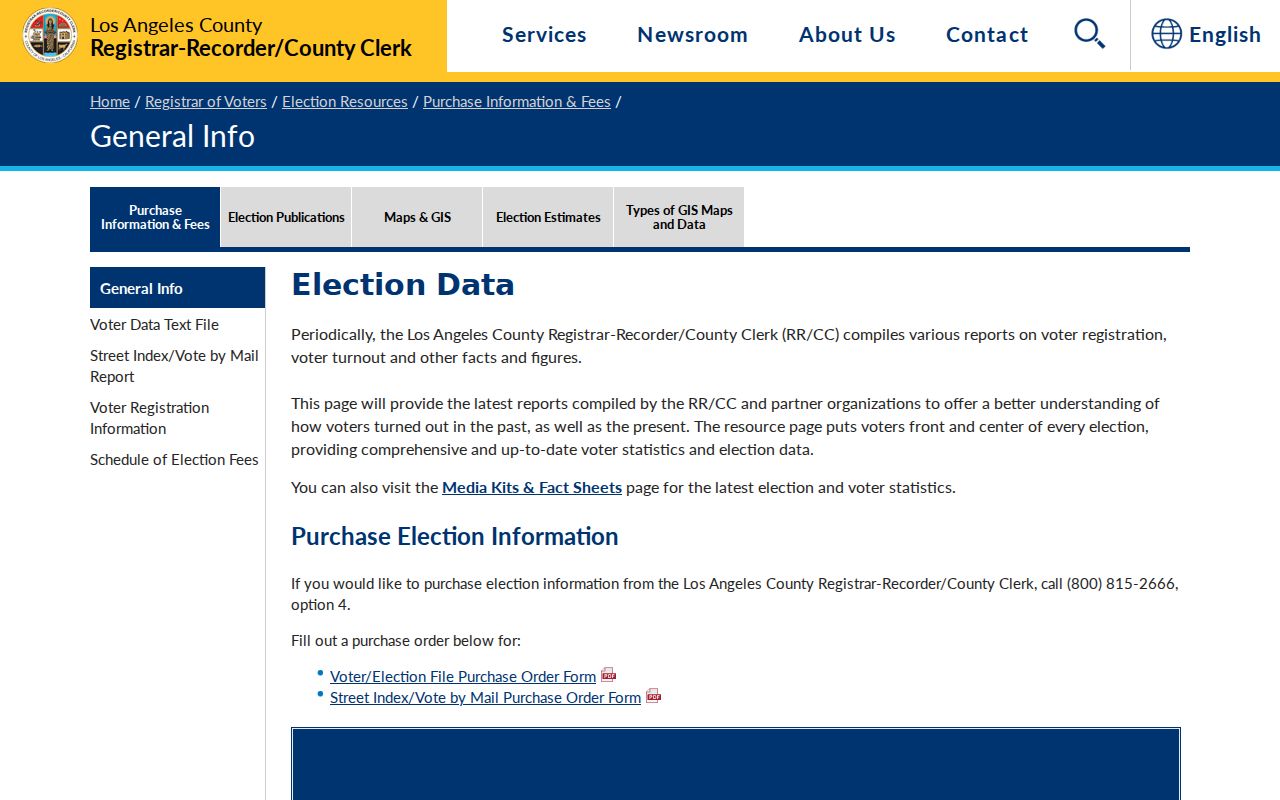
Use a self-check for the person who is confirming their own record, and do not turn an authorized election file into a general list of nearby households.
Monterey Park Neighbor Watch Contacts
No official current neighborhood-association inventory or public member roster was located. That absence is useful evidence: it means a block search should use public institutional contacts and published meeting routes, not invent a list of association names or members. Monterey Park's Neighborhood Watch program forms by block. Residents elect a block captain, meet with Police, and complete an eight-step program before signs are installed. The program does not publish a captain or participant roster.
| Institution or program | What it can add | Public contact and access |
|---|---|---|
| Neighborhood Watch and Community Engagement Bureau | Block-captain program, Police contact, meeting route, and eight-step program details | 626-307-1215; ask about the public program route, not private membership |
| Monterey Park Historical Museum and Historical Society | Photographs, artifacts, community history, and institutional reference context | 781 S Orange Ave; Saturday and Sunday 2 to 4; weekday tours by appointment; 626-307-1267 |
| Bruggemeyer Library Reference | Directories, microfilm, yearbooks, council minutes, newspapers, and oral histories | 318 S Ramona Ave; appointment required; Reference 626-307-1368 |
Community groups, congregations, and civic clubs may publish an officer or meeting contact, but a public institution listing is not a member directory. Ask for a meeting, archive, or published contact route when the goal is to learn the history of a block.
Compare Official Sources for Monterey Park Neighbors
Official and commercial neighbor-lookup categories serve different purposes. Official sources preserve a custodian, date, field label, and access rule. Commercial compiled tools may join public and purchased data into a profile, but the result can be stale, conflated, or stripped of the record context that would let a researcher test it. Use a compiled profile only as an unverified lead, never as the final answer about a block.
| Source category | Best use | Key limit |
|---|---|---|
| Assessor map and roll | Parcel geometry, AIN, situs, values, and property characteristics | Owner names are limited online; no complete household list |
| Recorder index and deed image | Named ownership event and legal description for one identified parcel | Offline party-and-year search; an owner is not every occupant |
| City permit and code file | Work, inspections, applicants, responsible parties, and dated notices | Privacy, investigation, and role limits apply |
| Library, minutes, and newspapers | Past listed occupants, civic voices, events, and neighborhood history | Publication date and context control the meaning |
| Commercial compiled neighbor tool | Possible lead for a name or address to verify elsewhere | No guaranteed freshness, provenance, or custodian correction path |
The official route takes more steps because each source answers one narrow question. That extra context is what lets nearby neighbors be described without turning a parcel map into an invasive roster.
Privacy Limits for Monterey Park Neighbors
A block record cannot lawfully fill every gap. Some occupants, children, unlisted household members, utility customers, delivery recipients, and DMV address holders are not an open public list. The Driver's Privacy Protection Act, 18 U.S.C. §§2721-2725, restricts motor-vehicle personal data. Owner, mail recipient, permit applicant, and resident remain separate roles. California Safe at Home gives qualifying victims and certain reproductive-health workers or patients a substitute mailing address, so a protected address must not be defeated by cross-checking.
California's Megan's Law website is a statutory public tool with its own use limits. It may provide registrant name, photo, physical description, address or map and radius information, risk, and offense fields as authorized. It is not a general block roster and is never a reason to confront or monitor a person. Verify any entry through the official site and follow its warning against harassment.
The official California Megan's Law site is the source for the statutory search interface and its public-use warning.
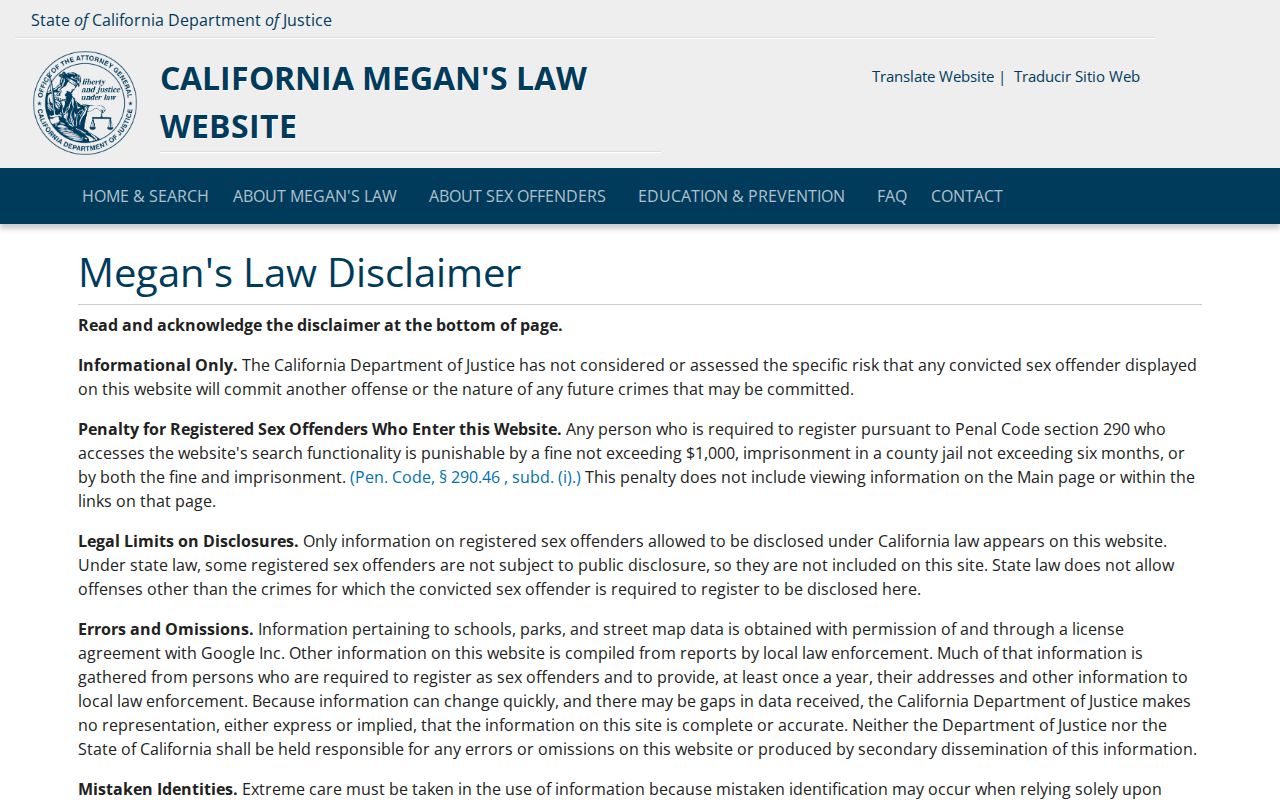
The map can support a lawful safety question, but it cannot justify intimidation, public shaming, or a claim that every person at a nearby address is a registrant.
Lawful use. Use block records for personal safety awareness, family history, reconnection, and civic understanding. Do not stalk, follow, threaten, dox, or harass a person; public access never removes California's anti-stalking and harassment limits.